

Quick Answer: For most people, the nicotine withdrawal timeline follows a predictable pattern. Physical withdrawal begins within 4 to 24 hours of your last cigarette or vape, peaks around days 2 to 3, and eases over the following 2 to 4 weeks. The psychological side, the cravings tied to habits and routines, can linger longer, but it gets weaker every time you resist it. Withdrawal is not a sign that quitting is failing. It is your brain adjusting to life without nicotine.
If you are searching for a nicotine withdrawal timeline, you are really asking one quiet question underneath it: when does this get easier?
The honest answer is that it gets easier sooner than most people expect, and in a more predictable way than it feels in the moment. Withdrawal is not random. It has a shape. Once you can see that shape, the whole thing stops feeling like an ambush and starts feeling like weather you can wait out.
This guide walks you through what happens after your last cigarette, hour by hour and day by day, and separates what your body is doing from what your brain is telling you. Those two things are not the same, and knowing the difference is one of the most useful tools you have.
What is nicotine withdrawal?
Nicotine is one of the fastest-acting addictive substances there is. Every cigarette delivers it to your brain within seconds. Do that enough times a day for enough years, and your brain adapts. It grows extra nicotine receptors and starts expecting regular doses throughout the day. That expectation quietly becomes your normal.
When you stop, the nicotine level in your blood begins to fall, and your brain notices almost immediately. Not because something is wrong. Because something has changed. All those extra receptors are suddenly sitting there with nothing to do, and for a while, your brain produces less dopamine, the chemical tied to motivation, reward, and focus.
That dip is why quitting can leave you feeling irritable, restless, low, unfocused, hungry, or anxious. According to Cleveland Clinic, cravings are the most common symptom, alongside difficulty concentrating, sleep disruption, and increased appetite. None of it means you made the wrong decision. It means your brain is adapting.
Here is the part worth holding onto: the same brain that learned to smoke is fully capable of learning not to. Boss would put it plainly. You are not broken. You are recalibrating.
Why does withdrawal feel worse than it really is?
Most people do not relapse because withdrawal is unbearable. They relapse because withdrawal feels permanent. That is the trick your brain plays, and it is worth understanding before it happens to you.
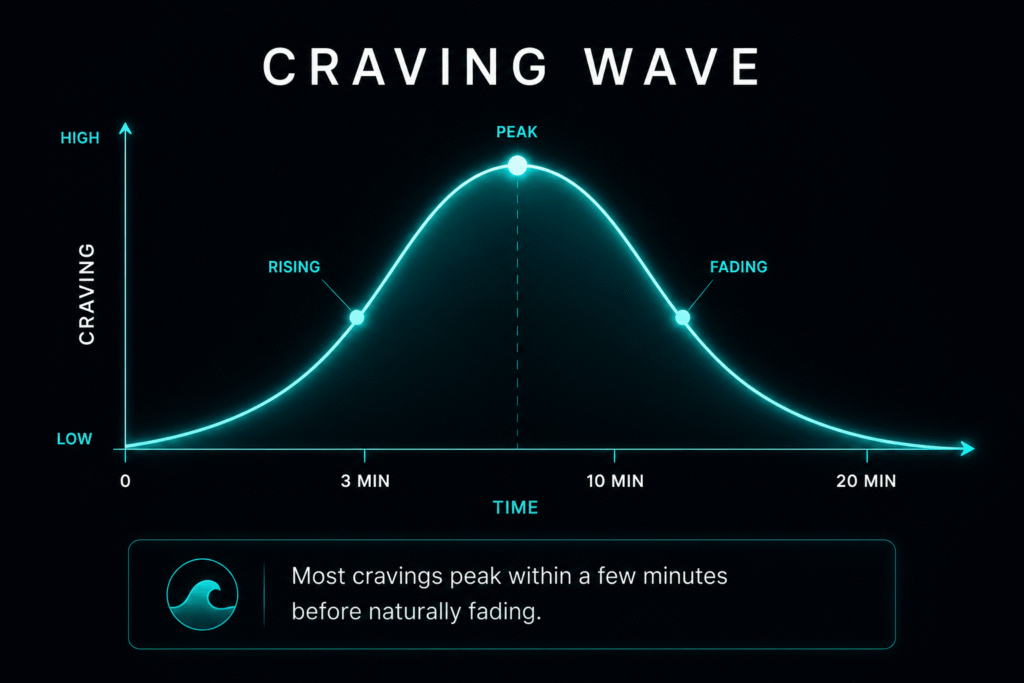
Picture standing on a beach with a wave rolling toward you. As it builds, it looks enormous, like it will knock you flat. Then it reaches you, and thirty seconds later it is gone. Cravings work almost exactly the same way. They build, they peak, and then they fall. Every craving you have ever had has ended. Every single one.
The problem is that while you are standing in the middle of one, your brain whispers this feeling is not going away. It is lying. The goal is not to make cravings vanish instantly. The goal is to stay standing while the wave passes.
You do not have to win the next six months. You only have to win the next few minutes.
That small shift changes how people experience the whole process. Instead of fighting forever, you are simply waiting for a wave to pass. And waves always pass.
Your nicotine withdrawal timeline, step by step
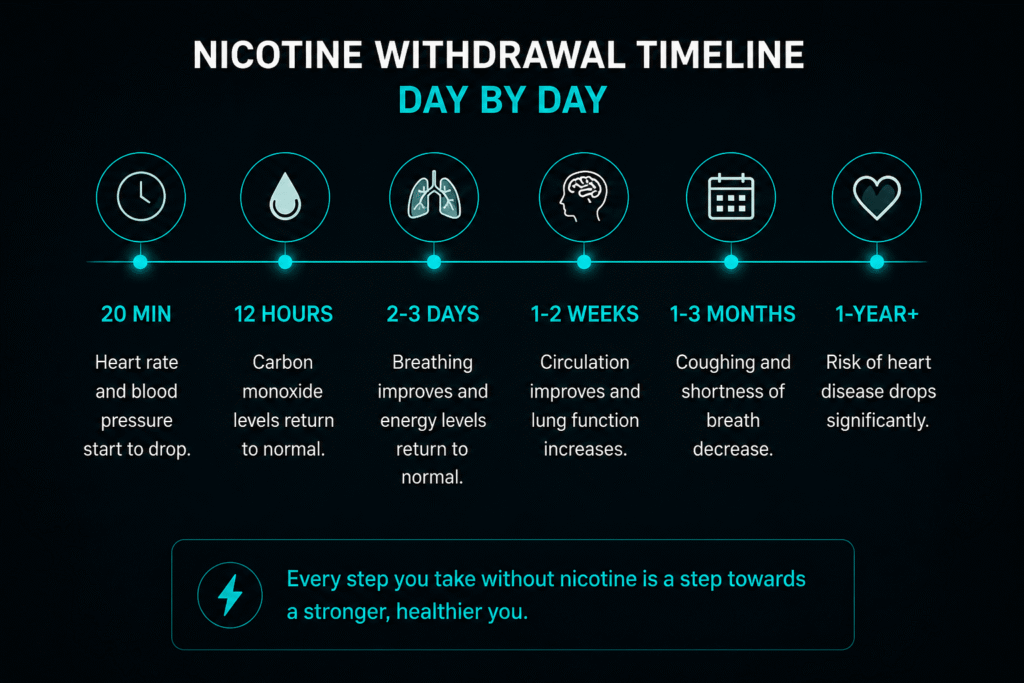
Every person is different. How long you smoked, how heavily, whether you vape or use nicotine replacement therapy, all of it shapes your experience. But for most people, the timeline follows the pattern below. Treat it as a map, not a promise.
The first 20 minutes
Something starts before you have even finished watching a TV episode. According to the CDC, within about 20 minutes of your last cigarette, your heart rate begins to drop back toward normal. Smoking raises your heart rate and blood pressure, and stopping starts easing that strain almost right away.
You probably will not feel dramatically different. But your body already knows what you are trying to do. Recovery does not start weeks later. It starts almost immediately, which is the opposite of what most people assume.
Around 12 hours
About 12 hours after your final cigarette, another shift takes place. Carbon monoxide, a poisonous gas in cigarette smoke that reduces your blood’s ability to carry oxygen, drops back toward normal. As it clears, oxygen levels rise, and your heart no longer has to work as hard to move oxygen around your body.
Inside, things are already improving. Outside, you may start to feel worse, and that is completely normal. This is often when the first withdrawal symptoms appear: irritability, restlessness, mild headaches, more hunger, and a stronger urge to smoke. It is not damage. It is adjustment.
24 hours
By the one-day mark, two things are true at once. The CDC notes that the nicotine level in your blood drops to zero around 24 hours after your last cigarette. At the same time, your risk of heart attack has already begun to edge down. This is also the window where many people feel the mental side sharpen: anxiety, frustration, a short fuse, a restless need to do something with your hands.
This is the day the wave starts building in earnest. It helps to keep your environment simple: remove lighters, ashtrays and leftover packs, and make your old routines a little less convenient.
Days 2 to 3: the peak
This is the hardest stretch for most people, and it is important to say that clearly so it does not catch you off guard. The NHS and Cleveland Clinic both describe withdrawal symptoms peaking around the second or third day nicotine-free. Cravings feel most intense, sleep can be broken, concentration slips, and mood swings show up uninvited.
Here is the reframe that matters. Day 2 and day 3 are not withdrawal getting worse. They are withdrawal at its loudest, which is a very different thing. This is the crest of the wave. Cleveland Clinic puts it simply: symptoms get a little better every day, especially after the third day. If you can stay standing through this window, the trend is on your side from here.
Days 4 to 7: the turn
By the end of the first week, most people notice the sharpest edges starting to dull. Physical symptoms like headaches begin to fade, sleep starts to settle, and energy creeps back. The cravings do not disappear, but they become less constant and easier to ride out.
Evenings can still feel unsteady, especially the quiet routines that used to include a cigarette. That is normal. The timeline is shifting now from raw physical withdrawal toward habit and trigger, which is a fight you are much better equipped to win.
Weeks 2 to 4
Across the first month, the acute physical phase largely resolves. Research using brain imaging has shown that the extra nicotine receptors your brain built up begin returning toward non-smoker levels within roughly two to three weeks, which is the biology underneath why things ease. Most physical symptoms have faded or become mild by the end of this window.
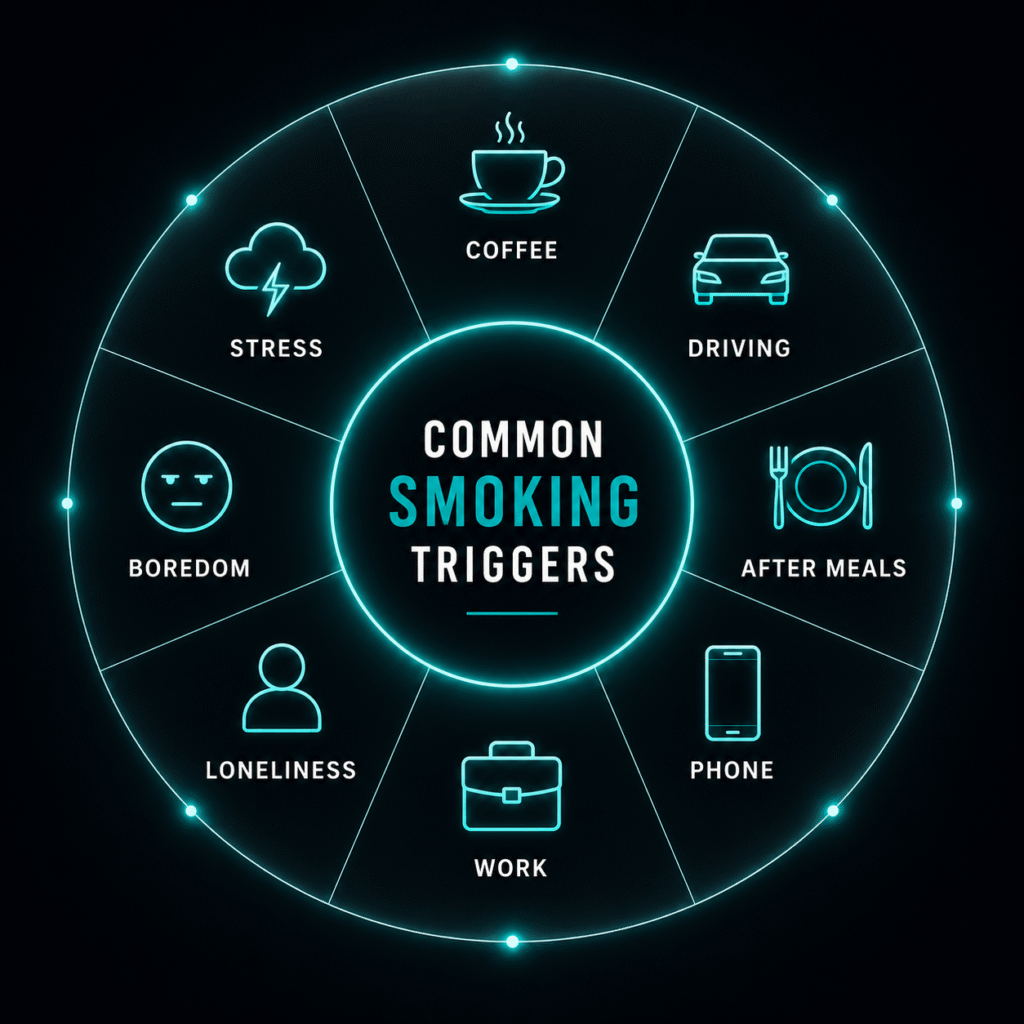
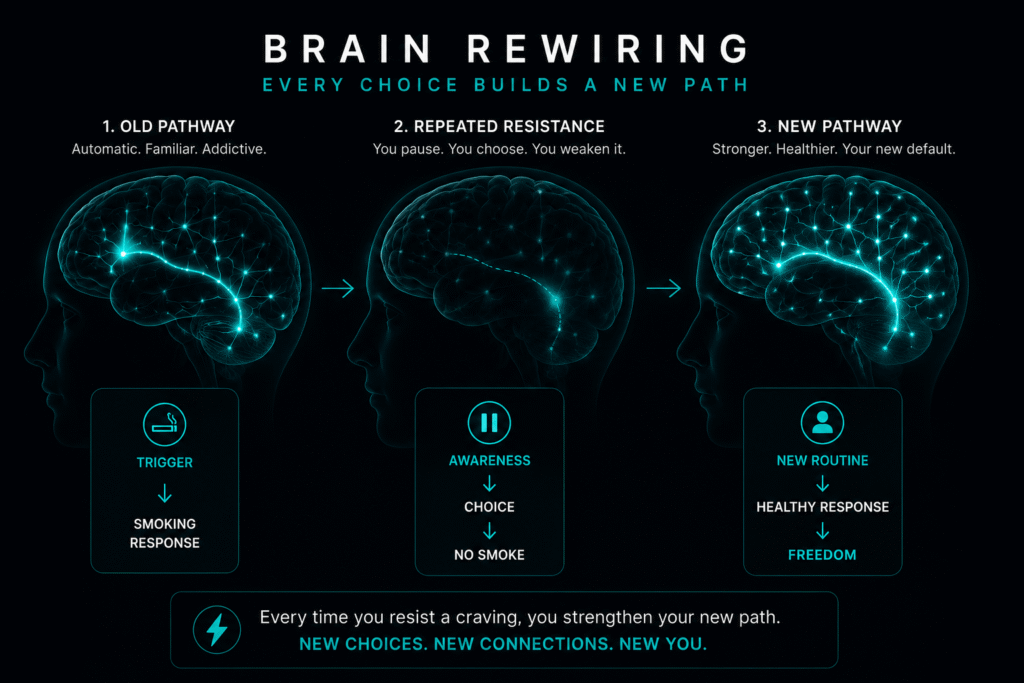
What tends to remain is situational: the coffee, the drive, the phone call, the drink, the break at work. These are not nicotine cravings so much as memory cravings, your brain reaching for a cue it associated with smoking. Each time you meet one of those moments without smoking, you teach your brain a new pattern, and the pull weakens.
Months 1 to 3 and beyond
From here, cravings become less frequent and shorter. Appetite changes may still linger, and mood generally stabilises as your brain chemistry finds its new balance. Over the months that follow, the cravings that remain are usually tied to specific triggers, and they fade in intensity over time.
This is the stage where identity does the heavy lifting. You are no longer someone trying not to smoke. You are becoming someone who does not.
Related Article: How to Quit Smoking for Good (Even If You’ve Tried Before)
Common nicotine withdrawal symptoms
Symptoms vary from person to person, but the documented, expected ones are consistent across health authorities. You may experience some, all, or a shifting mix of the following:
- Strong cravings to smoke, the most common symptom of all
- Irritability, frustration or a short temper
- Restlessness and difficulty sitting still
- Trouble concentrating or a foggy, distractible feeling
- Anxiety or low mood
- Disrupted sleep, including trouble falling asleep or vivid dreams
- Increased hunger and appetite
- Headaches and, for some, a temporary cough as the lungs clear
One important note on mental health. Low mood and anxiety are recognised withdrawal symptoms and usually ease within two to four weeks. But if they persist beyond a month, feel severe, or frighten you, that deserves proper support rather than a solo endurance test. Sometimes quitting unmasks something that was being quietly self-medicated, and a clinician can help. Reaching out is strength, not failure.
Related Article: Why Willpower Fails When Quitting Smoking (What Works)
What actually helps you get through it
Knowing the timeline is half the battle. The other half is having something to do while the waves pass. These are the approaches health authorities consistently support:
- Nicotine replacement therapy. Patches, gum, lozenges, inhalers and sprays are endorsed by the NHS and Cleveland Clinic as evidence-based ways to soften withdrawal. Used properly, NRT can roughly double your chances of quitting successfully. It is not cheating. It is using the right tool.
- Ride the wave, do not fight it. When a craving hits, name it, notice it building, and remind yourself it will crest and fall within minutes. Delay, distract, breathe. You are not resisting forever, only outlasting one wave.
- Change your environment early. In the first hours and days, remove the cues. Clear out cigarettes and lighters, and disrupt the routines that used to include smoking.
- Hydrate, move, and sleep. Water, a short walk, and protected sleep all take real edge off the physical symptoms.
- Do not face the hard moments alone. Support is one of the strongest predictors of success. That is exactly why Boss exists: to be there in the specific moment a craving hits, remember your patterns, and coach you through it instead of leaving you to white-knuckle it.
The bottom line
The nicotine withdrawal timeline is real, it is predictable, and it is finite. Physical withdrawal begins within hours, peaks around day 2 to day 3, and eases across the first few weeks. The cravings tied to habit last longer but weaken every single time you meet them without giving in.
The most useful thing you can carry through it is this: withdrawal is not proof that quitting is going badly. It is proof that your brain is adjusting, exactly as it is supposed to. The discomfort is the sound of recovery happening. You do not have to win the whole war today. You only have to win the next few minutes, and then the next. That is a fight you can absolutely win, and you do not have to fight it alone.
Frequently asked questions
How long does nicotine withdrawal last?
For most people, physical nicotine withdrawal symptoms begin within 4 to 24 hours of quitting, peak around day 2 to day 3, and largely resolve over the following 2 to 4 weeks. Psychological cravings tied to habits and triggers can persist for several weeks to a few months, but they become less frequent and less intense over time.
When is nicotine withdrawal at its worst?
Withdrawal is usually most intense on the second and third day after your last cigarette. This is the peak of the physical symptoms. According to Cleveland Clinic, symptoms then improve a little every day, especially after the third day.
How long until nicotine leaves your body?
The nicotine level in your blood drops to zero around 24 hours after your last cigarette, according to the CDC. Carbon monoxide from smoke clears within about 12 hours. The extra nicotine receptors in your brain take longer, returning toward non-smoker levels over roughly two to three weeks.
Does nicotine withdrawal cause anxiety and low mood?
Yes. Anxiety, irritability and low mood are recognised withdrawal symptoms and usually ease within two to four weeks. If they persist beyond a month or feel severe, speak to a clinician, as quitting can sometimes reveal an underlying condition that benefits from proper support.
Does nicotine replacement therapy make withdrawal easier?
Yes. Nicotine replacement therapy such as patches, gum and lozenges is supported by the NHS and Cleveland Clinic as an evidence-based way to reduce withdrawal severity, and it can roughly double your chances of quitting successfully. It is a legitimate tool, not a failure of willpower.
Related Article: Nicotine Withdrawal
Related Article: Nicotine withdrawal is much longer than 3 days.