

Quick Answer: Here is how to quit vaping: pick a quit date, choose one method and commit to it, either stopping outright or stepping your nicotine strength down, then use nicotine replacement therapy to blunt the withdrawal and build support around the moments you know are hardest. Withdrawal peaks in the first few days and eases over two to four weeks. One important exception: if you switched to vaping to get off cigarettes, do not quit vaping unless you are confident you will not go back to smoking. Vaping is far from harmless, but it is substantially less harmful than tobacco.
It is probably late. You are probably holding the thing right now, telling yourself this is the last one, the same way you did on Tuesday.
Here is what nobody tells you: the fact that you cannot seem to stop is not evidence that something is wrong with you. It is evidence that the device in your hand is extremely good at its job. Understanding exactly how good, and why, is the first real step to putting it down.
This is the practical guide to how to quit vaping. What actually works, what the evidence says, and what to expect.
Before you quit vaping, read this one warning
This matters more than anything else in this article, and most guides skip it entirely.
If you started vaping in order to stop smoking cigarettes, then the NHS advice is blunt and correct: only quit vaping if you are confident you can do it without returning to smoking. Withdrawal from vaping can make you reach for a cigarette, and that is a trade in the wrong direction.
Vaping is not safe. The CDC is clear that there are no safe tobacco products and that people who have never smoked should never start vaping. But between the two, cigarettes are considerably worse, and swapping a vape for a pack of twenty is not progress.
So be honest with yourself about which fight you are actually in. If cigarettes still have a hold on you, deal with those first, and come back to this when the ground is firmer.
Related Article. Willpower to Quit Smoking: Why It Fails and What Replaces It
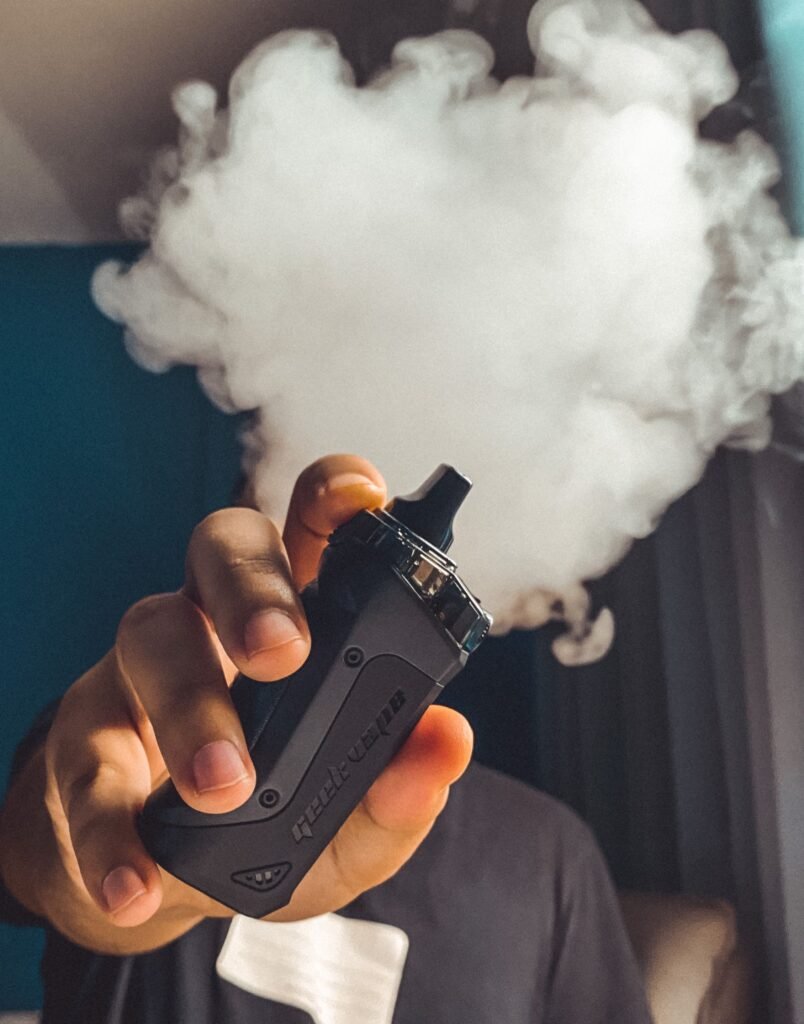
Why quitting vaping is harder than people expect
Quitting vaping is likely similar to quitting smoking, according to the CDC, because both involve nicotine addiction and both produce withdrawal. But vaping has two features that make it, in some ways, a stickier trap than cigarettes ever were.
It never ends
A cigarette has a built-in full stop. It burns down, you put it out, and the episode is over. That gives your brain a clean, countable unit: one cigarette, then a gap.
A vape has no ending. There is no ash, no butt, no moment where the thing is finished. So instead of twenty discrete events a day, you graze. Small hits, constantly, from the moment you wake until you fall asleep, often without even registering that you did it.
The result is that your brain almost never experiences the drop in nicotine that a smoker feels between cigarettes. Your levels stay topped up all day, which means the dependence gets reinforced almost continuously.
It can carry far more nicotine, far more comfortably
Older e-liquids used freebase nicotine, which is harsh on the throat at high strengths. That harshness acted as a natural brake on how much you could take.
Nicotine salts removed the brake. They deliver high concentrations of nicotine smoothly, so a device can hold a large dose that goes down easily. Combine that with all-day grazing and no natural stopping point, and you have a delivery system that can build a heavier dependence than the person using it ever intended.
You did not fail to control it. It was engineered to be difficult to control.
How to quit vaping: the seven steps that actually work
These are drawn from the CDC’s quitting guidance, the NHS, and the clinicians who do this for a living. There is no trick here, and anyone selling you one is lying. There is just a plan that has been shown to work when people follow it.
1. Pick a quit date, and make it soon
Not “after the holidays.” Not “when work calms down.” Work never calms down, and you know it. Choose a date within the next two weeks, close enough that you cannot hide from it, far enough away to prepare.
Write it down. Tell someone. A date you have said out loud behaves differently from a date you keep in your head.
2. Know exactly why, and make it specific
“It is bad for me” will not hold at 2am. It is too abstract, and your brain will trade it away in a heartbeat.
Get concrete. The money. The breathlessness climbing the stairs. The fact that you cannot get through a film without reaching for it. The quiet shame of hiding it. The person you want to be able to look at without wincing. Write down the two or three that actually make your stomach turn, and keep them somewhere you will see them when you are weak.
3. Choose one method and commit
There are two main routes and neither is morally superior. What matters is picking one and not drifting between them.
Stop outright. You set the date, and on that date the device goes in the bin. Withdrawal is sharper but shorter, and you get a clean break from the ritual. This suits people who find “just a bit less” impossible to hold.
Step the nicotine down. You move progressively to lower nicotine strengths over a set schedule before stopping. The trap here is obvious and worth naming: it is very easy to compensate by simply vaping more of the weaker liquid, which defeats the entire point. If you take this route, you need a written schedule and someone who knows you are on it.
4. Use nicotine replacement therapy
This is the step people skip because it feels like admitting weakness. That instinct is costing people their quit attempts.
Nicotine patches, gum and lozenges reduce cravings and withdrawal symptoms, and a Cochrane review has found evidence they help vapers specifically, not just smokers. In the UK, the NHS notes that a nicotine mouth spray is currently the only NRT licensed specifically for quitting vaping, and suggests combining a fast-acting product for cravings with a patch for steady background coverage.
Read the logic there. A patch handles the baseline so you are not permanently on edge. The fast-acting product handles the spikes. You are not “still addicted,” you are treating a chemical dependency with the tool designed for it, on a schedule that ends.

Talk to a pharmacist or your GP. It costs you nothing and it roughly doubles your odds.
5. Map your triggers before they fire
Because vaping is continuous, it welds itself to an unusual number of contexts: the first minute awake, the kettle boiling, the drive, the group chat, the moment a task gets boring, the cigarette-break-shaped hole at work, the sofa at 11pm.
Spend two days simply noticing when you reach for it. Do not try to stop, just notice. You will find three or four windows that account for most of it. Those are your real enemy, not “vaping” in the abstract.
Then change something structural about each one, in advance. Different chair. Different route. Phone in another room. Hands occupied. The NHS suggests declaring certain places and times vape-free and gradually expanding them, which works precisely because it shrinks the territory the habit occupies.
6. Have something for your hands and your mouth
A huge amount of vaping is not chemical at all. It is the ritual. The reach, the click, the inhale, the plume. Your body has learned a physical sequence and it will keep offering it up.
Give it something else. Water, gum, a cold drink, a walk. It sounds almost insultingly simple, and it works, because you are not trying to out-argue a craving, you are giving the ritual somewhere else to go.
On the walk specifically: randomised trials have found that even short bouts of moderate exercise, on the order of ten minutes, meaningfully reduce craving intensity. A ten-minute walk is not a platitude. It is one of the most reliable craving interventions available and it is free.
7. Do not do the hardest moments alone
Look honestly at where your last attempt died. It was almost certainly a specific, lonely moment. Late, tired, stressed, nobody around, and a craving filling the silence.
Support is one of the strongest predictors of success in every quitting study worth reading. Tell people. Team up with someone else who is quitting. Use a quit service. And if the moments that break you happen at 2am when there is nobody to text, get something that is actually awake at 2am. That is precisely the gap Boss was built to fill.
What to expect when you quit vaping
Withdrawal is uncomfortable and it is temporary, and the CDC makes a point worth holding onto: nicotine withdrawal cannot hurt you.
Expect cravings, irritability, restlessness, difficulty concentrating, low mood or anxiety, disrupted sleep, and increased appetite. Symptoms usually begin within hours, are loudest around the second and third day, and ease over the following two to four weeks as your brain adjusts.
Appetite changes are worth naming honestly, because fear of weight gain sends people back to nicotine. Nicotine suppresses appetite. When you remove it, that suppression lifts. Some weight change is normal and it usually settles. Do not let it be the reason you go back.
On mood: if low mood or anxiety persists beyond a month, or feels severe, that deserves a clinician rather than solo endurance. Sometimes quitting reveals something that was being quietly medicated, and that is a treatable thing, not a life sentence.
What if you slip?
Then you slip. It is a data point, not a verdict.
The NHS says plainly that it is okay if it takes a few tries. Most people who quit for good did not do it on the first attempt. The relapse is not the failure. The failure is deciding that the relapse proves something about you, and quietly giving up.
Boss only ever asks one question after a slip: what happened right before it? Because that answer is worth more than any amount of guilt. Guilt tells you who you are. Information tells you what to change.
The bottom line on how to quit vaping
Quitting vaping is hard for reasons that have nothing to do with your character. The device is continuous, it never ends, and it can carry a heavier nicotine load than you ever consciously chose. That is not a moral failing. That is design.
But the way out is well mapped. Pick a date. Pick one method. Use NRT rather than pride. Defuse your triggers before they fire, not while you are inside them. Move your body when the craving builds. And do not stand in the hardest moments on your own.
It will be loud for a few days. It gets quieter. Thousands of people have done exactly this, most of them after failing at least once, and almost none of them felt strong on the day they started. You do not have to feel strong. You just have to still be standing when the wave passes.

Frequently asked questions
How long does it take to quit vaping?
Physical withdrawal symptoms typically begin within hours, peak around the second or third day, and ease over the following two to four weeks. Cravings tied to habits and situations can persist longer but become less frequent and less intense each time you get through one without vaping.
Is it better to quit vaping cold turkey or taper down?
Both work, and neither is superior in principle. Stopping outright produces sharper but shorter withdrawal and gives a clean break from the ritual. Tapering the nicotine strength is gentler but requires a written schedule, because it is easy to compensate by vaping more of the weaker liquid. Choose one and commit rather than drifting between them.
Can nicotine patches or gum help you quit vaping?
Yes. Evidence including a Cochrane review indicates nicotine replacement therapy reduces cravings and withdrawal in people quitting vaping, not only in smokers. The NHS suggests combining a fast-acting product for craving spikes with a patch for steady background coverage. Speak to a pharmacist or GP.
Should I quit vaping if I used it to stop smoking?
Only if you are confident you will not return to cigarettes. The NHS advises exactly this. Vaping is not safe, but it is substantially less harmful than smoking, and swapping a vape for cigarettes is a step backwards. If tobacco still has a hold, address that first.
Why is quitting vaping so hard?
Because a vape has no natural endpoint. A cigarette burns out, but a vape can be used continuously all day, which keeps nicotine levels topped up and reinforces the dependence almost constantly. Nicotine salts also allow devices to deliver high nicotine doses smoothly, without the throat harshness that used to limit intake.